


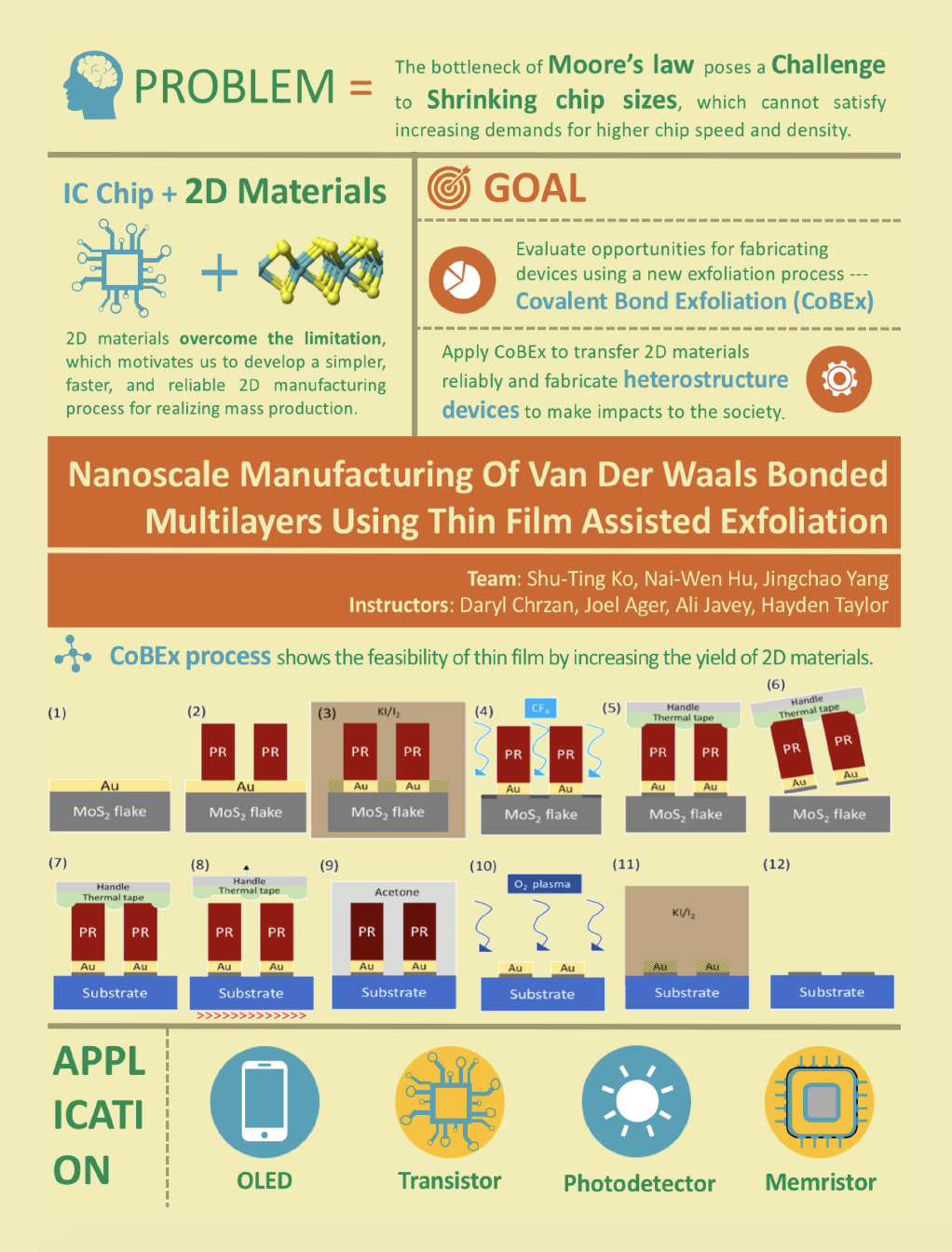
The team evaluated opportunities for fabricating electronic devices using a new exfoliation process, called “Covalent Bond Exfoliation.” They sought to apply this method to transfer 2D materials reliably and manufacture heterostructure devices massively to make impacts to the society.
Team: Shu-Ting Ko, Nai-Wen Hu, Jing Chao Yang
Advisors: Daryl Chrzan, Joel Ager, Ali Javey, Hayden Taylor
The Problem: The bottleneck of Moore’s law poses a challenge to shrinking chip sizes, which cannot satisfy increasing demands for higher chip speed and density.
The Goal: Evaluate opportunities for fabricating devices using a new exfoliation process — Covalent Bond Exfoliation (CoBEx). Apply CoBEx to transfer 2D materials reliably and fabricate heterostructure devices to make impacts to the society.
IC Chip+ 2D Materials: 2D materials overcome the limitation, which motivates us to develop a simpler, faster, and reliable 2D manufacturing process for realizing mass production.
Application:
- OLED
- Transistor
- Photodetector
- Memristor
← View all Capstone Projects